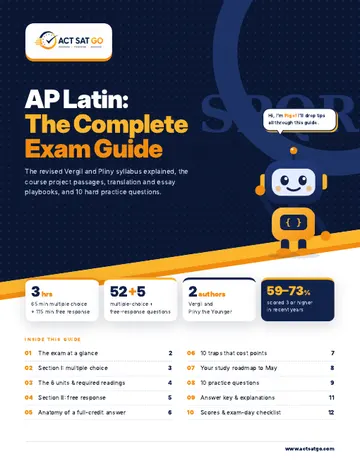
The exam at a glance
| Section | Weight | Timing | What you do |
|---|---|---|---|
| I · Multiple choice | 50% | 1 hr 5 min · 52 questions | Discrete questions, short sets and long sets on syllabus passages and unseen (sight) passages, plus Roman history and culture. |
| II · Free response | 50% | 1 hr 55 min · 5 questions | A set of short-answer questions on a syllabus passage, a literal translation, a short analytical essay, and two short essays on the year's course project passages. |
Everything happens in Bluebook
You answer every question, including the translation and essays, in College Board's Bluebook app. Practice typing timed answers, including macrons if your teacher uses them, before May.
Two in-class checkpoints
A summary-writing task and an interpretive product, completed during the year, count for 2% of your final AP score. Check the deadlines with your teacher.
The multiple-choice section
52 questions in 65 minutes gives you about 1 minute 15 seconds per question, including reading time for each passage. Know the syllabus passages very well, but practice sight reading weekly: unseen passages can't be memorized. Wrong answers lose no points.
Strategies that work
- Find the main verb first, then its subject and object.
- Use endings, not word order, to decide case and function.
- Know your grammar labels: ablative absolute, indirect statement, purpose and result clauses, gerundives.
- For scansion, mark syllables long by nature and by position before counting feet.
- Read the whole sentence before choosing a translation; context decides meaning.
- Never leave a blank. There is no penalty for guessing.
The 6 units, in plain English
Teacher's Choice: Latin Prose
Forms, syntax and reading fluency.
Be ready to: Review forms and syntax; read longer prose passages to build reading speed.
Pliny: The Eruption of Vesuvius
Letters 6.16 and 6.20.
Be ready to: Read the two letters about Mount Vesuvius (79 CE) and the death of Pliny the Elder.
Pliny: Other Letters
Roman social life and values.
Be ready to: Read letters on the supernatural, Trajan and Calpurnia; connect them to Roman society.
Teacher's Choice Poetry + Aeneid 1–2
Meter and the opening of the epic.
Be ready to: Learn dactylic hexameter; read Aeneas, Juno and the fall of Troy.
Aeneid 4, 6, 7, 11, 12
The heart of the epic.
Be ready to: Read Dido and Aeneas, the underworld, war in Italy and the poem's ending.
Course Project + Teacher's Choice
The year's project passages.
Be ready to: Read, translate and analyze the four project passages, which are new each year and appear in the two short essays.
College Board doesn't publish unit weights. Expect the syllabus passages (Vergil and Pliny) to carry most of the exam, with sight reading close behind. Using older review books? The revised course no longer includes Caesar's De Bello Gallico.
The 5 free-response questions
115 minutes for 5 questions. Translation rewards literal accuracy; the essays reward Latin evidence with clear interpretation.
Short-answer set
6–8 questions on a syllabus passage about grammar, meaning, context and style.
Quote the exact Latin words that support each answer.
Literal translation
Translate a syllabus passage as literally as possible. Each segment is scored for accuracy.
Keep every word's case, tense and number; don't paraphrase.
Short analytical essay
Interpret a syllabus passage, supporting your argument with Latin cited and translated or closely paraphrased.
Cite line numbers and analyze style, not just content.
Two short essays
Summarize and interpret prose and poetry from the year's course project passages.
Prepare the project passages as thoroughly as the syllabus.
Time plan: About 20 minutes for the short answers, 15 for the translation, 35 for the analytical essay and 45 for the two short essays. In translation, literal beats elegant: every case ending and tense must show in your English.
Habits that earn points
- Cite Latin for every claim, with line numbers.
- Translate or closely paraphrase every citation.
- Keep translations literal: case, tense, number.
- Prepare project passages as well as the syllabus.
- Stuck? Translate what you can; each segment scores.
10 traps that cost points
Reading in English word order
Latin word order is flexible. Use endings to find the subject and object.
Ablative confusion
Ablatives can show means, manner, time, place or cause. Context decides which.
Missing an ablative absolute
A noun and participle in the ablative, set off from the main clause, usually form an ablative absolute.
Indirect statement
After verbs of saying or thinking, look for an accusative subject and an infinitive.
Purpose vs result
Both use ut + subjunctive. A tam, ita or tantus in the main clause usually signals result.
Free translation
Paraphrasing loses points. Keep each word's grammatical form visible.
Elision in scansion
A final vowel or vowel + m elides before a word starting with a vowel or h.
Essays without Latin
Every claim in an essay needs Latin evidence, cited and translated.
Studying old syllabus texts
Caesar is no longer on the syllabus. Focus on Vergil and Pliny.
Ignoring sight reading
Unseen passages appear on the exam. Practice weekly.
A study roadmap to May
A steady plan beats a last-minute rush. Shift the months to match your teacher's pacing.
- Sep – Oct
Units 1–2: prose
Grammar review and Pliny's Vesuvius letters. Start a vocabulary list from the syllabus.
- Nov – Dec
Unit 3: Pliny
Pliny's other letters and Roman society. Practice literal translation weekly.
- Jan – Feb
Unit 4: Aeneid 1–2 and meter
Dactylic hexameter and the opening books. Begin analytical essays.
- Mar – Apr
Units 5–6: Vergil and the project
Aeneid 4, 6, 7, 11 and 12 and the year's project passages. Complete the in-class checkpoints.
- Early May
Full timed sections
Sight passages, translation and essays under timing.
- May 2027
Exam day
Friday, May 14, 2027 (afternoon session). Sleep well and confirm your start time with your AP coordinator.
3 practice questions
Original questions written by ACT SAT GO in the style of the exam. The free PDF has 10, with full explanations.
- Aeneid 1.1–4 · Translation
Arma virumque canō, Trōiae quī prīmus ab ōrīs / Ītaliam, fātō profugus, Lāvīniaque vēnit… The best translation of "fātō profugus" is:
- A fleeing from fate
- B an exile by fate
- C the fate of the exile
- D fated to flee
Show answer
Answer: B · an exile by fate. Profugus means "exile"; fātō is an ablative of cause or means: "an exile by fate".
- Pliny, Letters 6.16 · Syntax
Petis ut tibi avunculī meī exitum scrībam… The clause "ut tibi… exitum scrībam" is best described as:
- A A result clause
- B An indirect command
- C A temporal clause
- D An indirect question
Show answer
Answer: B · An indirect command. After a verb of asking (petis), ut + subjunctive forms an indirect command.
- Pliny, Letters 6.16 · Syntax
…quō vērius trādere posterīs possīs. This clause is best described as:
- A a result clause
- B an ablative absolute
- C a relative purpose clause using quō with a comparative
- D a conditional sentence
Show answer
Answer: C. Quō + a comparative (vērius) + subjunctive introduces a purpose clause: "so that you may more truthfully hand down…".
How students score
Ranges reflect recent College Board score distributions and shift a little each year. Credit and placement policies vary by college.
Aiming for a 5 in AP Latin?
Book a free diagnostic session. We'll find your weakest units, review your practice responses and give you a week-by-week plan to exam day.