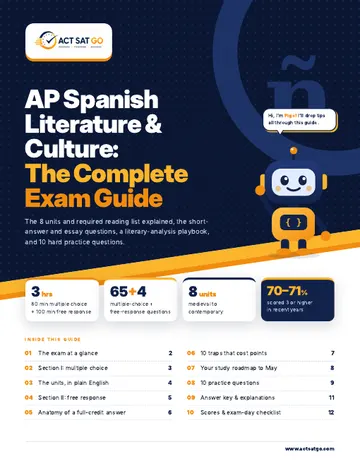
The exam at a glance
| Section | Weight | Timing | What you do |
|---|---|---|---|
| IA · Listening | 10% | 20 min · 15 questions | Authentic audio such as an author interview, a recited poem or a literary presentation. |
| IB · Reading | 40% | 1 hr · 50 questions | 6 sets of 7–10 questions on texts from different genres and periods, including one set pairing a required text with a non-required one. |
| II · Free response | 50% | 1 hr 40 min · 4 questions | 2 short answers (about 30 min): text explanation and text and art comparison. 2 essays (about 70 min): analysis of a single text and a text comparison on a theme. |
Everything happens in Bluebook
You answer every question, including the written responses, in College Board's Bluebook app. Practice typing timed answers in Spanish, with accents, before May.
Know every required work deeply
Free-response questions name works from the required list. For each one, know the author, period, movement, themes and key literary techniques.
Listening and reading
65 questions in 80 minutes. Reading is four times the weight of listening, and questions ask about meaning, literary devices, historical context and connections between texts. Wrong answers lose no points.
Strategies that work
- Identify genre and period first: they guide your interpretation.
- Know literary terms in Spanish: metáfora, hipérbaton, encabalgamiento, apóstrofe, ironía, narrador omnisciente.
- Connect texts to movements: Barroco, Romanticismo, Modernismo, Generación del 98, Boom.
- For paired texts, look for a shared theme and how each author treats it differently.
- Use context clues for unfamiliar words; don't stop reading.
- Never leave a blank. There is no penalty for guessing.
The 8 units, in plain English
La época medieval
The roots of Spanish literature.
Be ready to: Medieval Spanish literature and its religious and cultural values.
El siglo XVI
The early Golden Age.
Be ready to: The picaresque novel, Renaissance poetry and the encounter with the Americas.
El siglo XVII
The Baroque.
Be ready to: Cervantes, Sor Juana and the height of the Golden Age.
Romanticismo, realismo y naturalismo
The 19th century.
Be ready to: Emotion, social realism and determinism.
La Generación del 98 y el Modernismo
Crisis and renewal.
Be ready to: A crisis of identity in Spain and the renewal of poetic language in Latin America.
Teatro y poesía del siglo XX
Vanguard poetry and modern theater.
Be ready to: Including Lorca and Neruda.
El Boom latinoamericano
The 1960s–70s.
Be ready to: Magical realism and narrative experimentation.
Escritores contemporáneos
Recent writers.
Be ready to: Writers from the United States and Spain: identity, migration and memory.
The course moves through periods and movements, and each unit pairs required works with their historical and cultural context. Make a ficha (author, century, movement, themes, techniques) for every required work as you read it.
The 4 free-response questions
100 minutes for 2 short answers and 2 essays, all written in Spanish. Essays need literary analysis, not plot summary: explain how techniques create meaning.
Text explanation
Identify the author and period of an excerpt from a required work, and explain how it develops a theme.
Name the author, the work and the movement in your first sentence.
Text and art comparison
Compare how a required text and a work of art (painting, photo or sculpture) treat a shared theme.
Describe one specific detail from the artwork.
Analysis of a single text
Analyze how an author uses literary techniques to explore a theme in an excerpt from a required work.
Thesis + techniques + textual examples + effect on meaning.
Text comparison
Compare two excerpts on a shared theme, one from a required work and one not on the list, analyzing techniques.
Give both excerpts equal attention and evidence.
Time plan: About 15 minutes each for Q1 and Q2, and 35 minutes each for the two essays. Start with the question type you are strongest at, and never leave a question blank.
Habits that earn points
- Underline every task verb in the prompt.
- Write a defensible thesis in your first paragraph.
- Back every claim with specific evidence.
- Keep 2 minutes to reread and fix sentences.
- Stuck? Answer each part separately, in order.
10 traps that cost points
Plot summary
Retelling the story isn't analysis. Explain how techniques create meaning.
Terms in English
Use literary terms in Spanish: metáfora, símil, hipérbole, anáfora.
Wrong period or movement
Know each required work's century and movement precisely.
Neglecting one text
In Q4, analyze both excerpts with specific details, not just the familiar one.
Ignoring the artwork
In Q2, describe concrete details of the image, not just its theme.
Confusing author and narrator
The narrator or poetic voice is not automatically the author.
No thesis
Each essay needs a clear thesis about how the theme is developed.
Grammar errors that block meaning
Accurate Spanish matters; review accents and verb agreement.
Ignoring context
Historical and cultural context helps explain a work's themes.
Running out of time
Keep short answers short so the essays get enough time.
A study roadmap to May
A steady plan beats a last-minute rush. Shift the months to match your teacher's pacing.
- Sep – Oct
Units 1–3: medieval + Golden Age
Medieval works, the picaresque, Cervantes and Sor Juana. Build literary vocabulary in Spanish.
- Nov – Dec
Units 4–5: 19th century
Romanticism, Realism, the Generation of '98 and Modernismo. Write short text explanations.
- Jan – Feb
Unit 6: 20th century
Lorca, Neruda and the vanguard. Practice text-and-art comparisons.
- Mar – Apr
Units 7–8: Boom + contemporary
Magical realism and contemporary writers. Write timed comparison essays.
- Early May
Full timed sections
Listening, reading and all four free-response questions under timing. Review your fichas.
- May 2027
Exam day
Friday, May 14, 2027 (morning session). Sleep well and confirm your start time with your AP coordinator.
3 practice questions
Original questions written by ACT SAT GO in the style of the exam. The free PDF has 10, with full explanations.
- Poesía · Recursos
En la Rima XXI de Bécquer ("¿Qué es poesía?, dices mientras clavas / en mi pupila tu pupila azul…"), el último verso, "Poesía… eres tú", es principalmente un ejemplo de:
- A metáfora
- B hipérbaton
- C onomatopeya
- D aliteración
Show answer
Answer: A · metáfora. "Poesía… eres tú" directly identifies poetry with the beloved: a metaphor.
- Siglo XVII · Sor Juana
En "Hombres necios que acusáis", Sor Juana Inés de la Cruz critica principalmente:
- A la injusticia de la sociedad virreinal hacia los indígenas
- B la Iglesia católica
- C la doble moral de los hombres que culpan a las mujeres
- D la guerra de independencia
Show answer
Answer: C. Sor Juana's redondillas expose the double standard of men who blame women for behavior they themselves encourage.
- Análisis · Técnica
¿Cuál de estas oraciones sobre "La siesta del martes" es análisis literario, no resumen?
- A La madre llega al pueblo con su hija.
- B La historia ocurre un martes.
- C El narrador describe el calor sofocante, lo que intensifica la hostilidad del pueblo hacia la madre.
- D El cura abre la puerta.
Show answer
Answer: C. Analysis explains how a technique (the description of heat) creates an effect (intensified hostility).
How students score
Ranges reflect recent College Board score distributions and shift a little each year. Credit and placement policies vary by college.
Aiming for a 5 in AP Spanish Literature and Culture?
Book a free diagnostic session. We'll find your weakest units, review your practice responses and give you a week-by-week plan to exam day.