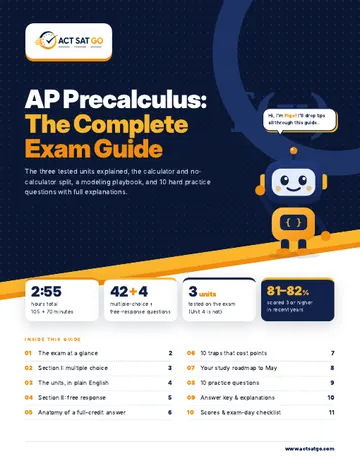
The exam at a glance
| Section | Weight | Timing | What you do |
|---|---|---|---|
| I · Multiple choice | about 63% | 1 hr 45 min · 42 questions | Part A: 29 questions in 65 minutes, no calculator (about 44%). Part B: 13 questions in 40 minutes, graphing calculator required for some (about 19%). |
| II · Free response | about 37% | 1 hr 10 min · 4 questions | Part A (calculator, 35 min): Q1 Function Concepts and Q2 Modeling a Non-Periodic Context. Part B (no calculator, 35 min): Q3 Modeling a Periodic Context and Q4 Symbolic Manipulations. Each is worth 6 points. |
Click in Bluebook, write on paper
You answer multiple-choice questions and read the free-response questions in the Bluebook app, then handwrite free-response answers in a paper booklet.
Units 1–3 only
The exam covers polynomial and rational, exponential and logarithmic, and trigonometric and polar functions. Unit 4 (parameters, vectors and matrices) is taught but not tested.
The multiple-choice section
Part A gives you 29 questions in 65 minutes without a calculator (about 2¼ minutes each). Part B gives 13 questions in 40 minutes with a graphing calculator (about 3 minutes each). Wrong answers lose no points.
Strategies that work
- Use rates of change: constant first differences mean linear, constant second differences mean quadratic, constant ratios mean exponential.
- Factor first to find zeros, holes and vertical asymptotes of rational functions.
- Log rules are tools. Combine logs before solving, then check that answers are in the domain.
- Know the unit circle cold for Part A: exact values at multiples of π/6 and π/4.
- In Part B, graph and use intersect or zero instead of solving by hand.
- Flag and move on after 3 minutes. Return once the quick points are banked.
The 4 units, in plain English
Polynomial & Rational Functions
How functions change, and the shapes of polynomials and rational functions.
Be ready to: Describe rates of change and concavity; find zeros with multiplicity and end behavior; identify holes and vertical and horizontal asymptotes; solve inequalities; work with transformations and function models.
Exponential & Logarithmic Functions
Growth and decay, and the inverse functions that undo them.
Be ready to: Compare arithmetic and geometric sequences; build exponential models; use log properties to solve equations; find inverses and compositions; use semi-log plots to linearize data.
Trigonometric & Polar Functions
Periodic behavior, the unit circle and polar graphs.
Be ready to: Use sine, cosine and tangent on the unit circle; find amplitude, period, phase shift and midline; model periodic situations; use identities and inverse trig to solve equations; graph polar functions.
Parameters, Vectors & Matrices
Taught to prepare for calculus, but not on the AP Exam.
Be ready to: Use parametric functions, vectors and matrices for transformations. Your teacher may still assess it in class.
The three tested units are close to equal, so your weakest unit is your biggest opportunity, and trigonometry is where most students lose points. Rates of change, composition and inverses are the exact ideas AP Calculus builds on.
The 4 free-response questions
70 minutes, 4 questions, 6 points each (24 raw points, about 37% of your score). Part A (calculator) and Part B (no calculator) are timed separately, 35 minutes each.
Function Concepts
Given a graph or table, describe behavior: where the function increases, its rate of change, concavity, and values of compositions or inverses.
Use precise words: "increasing at an increasing rate".
Modeling a Non-Periodic Context
Build a linear, quadratic, exponential or logarithmic model from data, use it to predict, and explain its limitations.
Write the model with numbers, then interpret each parameter in context.
Modeling a Periodic Context
Build a sinusoidal model from a situation such as a Ferris wheel or tides, then interpret amplitude, period and midline.
Find the midline and amplitude from the maximum and minimum first.
Symbolic Manipulations
Rewrite and solve expressions and equations using exponent, log and trig identities.
Show each algebra step; points are given for correct intermediate forms.
Time plan: About 17–18 minutes per question. On modeling questions, interpret in context: "the population grows by 8% per year", not just "b = 1.08".
Habits that earn points
- Label each part: (a), (b), (c).
- Write models with real numbers, then interpret every parameter.
- Include units and context in every modeling answer.
- Keep answers exact in no-calculator parts.
- Stuck? Write the equation you would solve. It can still earn credit.
10 traps that cost points
Holes vs asymptotes
A factor that cancels gives a hole, not a vertical asymptote. Factor before deciding.
Extraneous log solutions
After solving log equations, check every answer: arguments of logs must be positive.
Percent growth over different periods
Q = a(1.2)^(t/3) grows 20% every 3 years, which is about 6.3% per year, not 20%.
Degrees vs radians
AP Precalculus uses radians. Check your calculator mode before Part B.
Period vs frequency
For sin(bx), the period is 2π/b. A bigger b means a shorter period.
Multiplicity ignored
At a zero of even multiplicity the graph touches and turns; at odd multiplicity it crosses.
Losing inverse-trig range
arcsin and arctan give values in [−π/2, π/2]; arccos gives [0, π]. Find the other solutions yourself.
Wrong end behavior
End behavior depends on the leading term only, including its sign and degree.
Negative r in polar
When r < 0, the point is plotted in the opposite direction of θ.
Bare numbers in context
Modeling answers need units and a sentence about what the number means.
A study roadmap to May
A steady plan beats a last-minute rush. Shift the months to match your teacher's pacing.
- Sep – Nov
Unit 1: polynomial and rational functions
Rates of change, zeros, end behavior and asymptotes. Practice describing graphs in words every week.
- Dec – Jan
Unit 2: exponentials and logs
Growth models, log rules, inverses and semi-log data. One modeling question (Q2 style) per week.
- Feb – Mar
Unit 3: trigonometry and polar
Unit circle, sinusoidal models, identities and polar graphs. Drill exact values until they are automatic.
- April
Timed sections
Finish Unit 4 in class, but spend review time on Units 1–3. Take full timed sections, splitting calculator parts.
- Early May
Fix weak spots
Redo every missed question. Review the traps list and practice symbolic manipulations without a calculator.
- May 2027
Exam day
Tuesday, May 11, 2027 (morning session). Sleep well and confirm your start time with your AP coordinator.
3 practice questions
Original questions written by ACT SAT GO in the style of the exam. The free PDF has 10, with full explanations.
- Unit 1 · Rational functions
For f(x) = (x² − 4)/(x² − x − 2), which statement is true?
- A f has a hole at x = 2 and a vertical asymptote at x = −1
- B f has vertical asymptotes at x = 2 and x = −1
- C f has a horizontal asymptote at y = 4
- D f has a hole at x = −1
Show answer
Answer: A. f = (x − 2)(x + 2) / ((x − 2)(x + 1)). The x − 2 cancels (hole at x = 2); x + 1 stays (vertical asymptote at x = −1). Equal degrees give a horizontal asymptote at y = 1.
- Unit 2 · Log equations
What is the solution set of log₂(x) + log₂(x − 6) = 4?
- A {8}
- B {−2, 8}
- C {4}
- D {10}
Show answer
Answer: A · {8}. Combine: log₂(x(x − 6)) = 4, so x² − 6x − 16 = 0 and x = 8 or −2. x = −2 makes the logs undefined, so it is extraneous.
- Unit 3 · Trig equations
How many solutions does 2sin²θ − sin θ − 1 = 0 have on 0 ≤ θ < 2π?
- A 1
- B 2
- C 3
- D 4
Show answer
Answer: C · 3. Factor: (2sin θ + 1)(sin θ − 1) = 0. sin θ = 1 gives π/2; sin θ = −1/2 gives 7π/6 and 11π/6.
How students score
Ranges reflect recent College Board score distributions and shift a little each year. Credit and placement policies vary by college.
Aiming for a 5 in AP Precalculus?
Book a free diagnostic session. We'll find your weakest units, review your practice responses and give you a week-by-week plan to exam day.