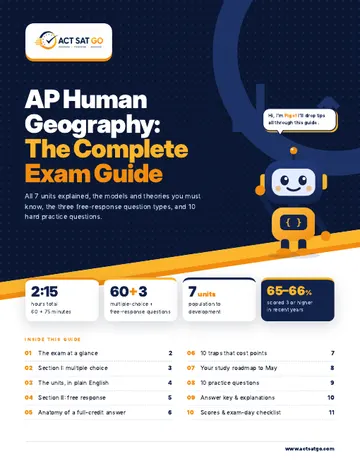
The exam at a glance
| Section | Weight | Timing | What you do |
|---|---|---|---|
| I · Multiple choice | 50% | 1 hr · 60 questions | Analyze geographic concepts, data from maps, charts and graphs, and spatial relationships at different scales. |
| II · Free response | 50% | 1 hr 15 min · 3 questions | Q1 has no stimulus (text only), Q2 uses one stimulus (data, image or map) and Q3 uses two stimuli. Each question has several parts (A–G). |
Everything happens in Bluebook
You answer every question, including the written responses, in College Board's Bluebook app. Practice typing timed answers before May.
Scale and patterns matter
Human Geography asks where things are and why there. Practice explaining patterns at local, regional, national and global scales.
The multiple-choice section
60 questions in 60 minutes, exactly one minute each. Maps and charts take longer, so answer vocabulary questions quickly. Wrong answers lose no points.
Strategies that work
- Read the map title, legend and scale before the question.
- Match the model to the clue: stages and birth rates mean the demographic transition; zones and rings mean urban models.
- Know your vocabulary precisely: relocation vs expansion diffusion; push vs pull factors.
- Think about scale: an answer can be true globally but false locally.
- Eliminate extreme words like "always" and "only".
- Move on at one minute and come back to flagged maps.
The 7 units, in plain English
Thinking Geographically
Maps, data and spatial ideas.
Be ready to: Read maps and projections; use GIS, GPS and data; explain scale, region, distance decay and human-environment interaction.
Population & Migration
Where people live and why they move.
Be ready to: Use population pyramids, density and the demographic transition model; explain Malthus; push-pull factors and types of migration.
Cultural Patterns & Processes
How culture spreads and changes.
Be ready to: Explain cultural landscapes; types of diffusion; the spread of languages and religions; globalization and acculturation.
Political Patterns & Processes
States, nations and boundaries.
Be ready to: Distinguish state, nation and nation-state; boundary types; federal and unitary states; devolution and supranationalism.
Agriculture & Rural Land Use
How and where food is produced.
Be ready to: Explain the agricultural revolutions; von Thünen's model; commercial and subsistence farming; the Green Revolution; food systems and sustainability.
Cities & Urban Land Use
How cities are organized.
Be ready to: Apply urban models (Burgess, Hoyt, Harris-Ullman, Latin American, African, Southeast Asian); central place theory; the rank-size rule; urban challenges and sustainability.
Industrial & Economic Development
Why some places are richer than others.
Be ready to: Explain the Industrial Revolution's spread; economic sectors; measures of development (GDP, HDI, GII); Rostow and Wallerstein; Weber's location theory.
Units 2–7 each carry about the same weight, so balance your review, and Unit 1's map skills and scale ideas appear inside every other unit. Learn every model with one limitation: the demographic transition, von Thünen, Burgess, Rostow, Wallerstein and Weber. Free-response questions often ask where a model fails to explain the real world.
The 3 free-response questions
75 minutes, 3 questions of 7 parts each, all worth the same 7 points. The stimulus pattern is the same every year: none, one, then two.
No stimulus
A scenario or concept with no map or chart. You define, describe, explain and apply concepts from memory.
Use precise vocabulary and a real-world example for each part.
One stimulus
A map, chart, image or table to interpret, then connect to concepts and explain patterns.
Quote specific data from the stimulus in your answer.
Two stimuli
Two sources to compare and connect, often at different scales or time periods.
Refer to both stimuli, and say which one you are using.
Time plan: About 25 minutes per question. Each part has a task verb (identify, describe, explain, compare): do exactly what it asks.
Habits that earn points
- Match the task verb in each part exactly.
- Use precise vocabulary from the course.
- Give a real place as an example when asked.
- Refer to the stimulus by name in Q2 and Q3.
- Stuck? Define the key term; it can still earn a point.
10 traps that cost points
Nation vs state
A state is a political unit with sovereignty; a nation is a group with a shared culture. A nation-state is where they match.
Types of diffusion
Relocation diffusion spreads by people moving; expansion diffusion (hierarchical, contagious, stimulus) spreads while staying in place.
Arithmetic vs physiological density
Physiological density is people per unit of arable land, so it reveals pressure on farmland.
Push vs pull
Push factors make people leave; pull factors attract them to a destination.
Wrong urban model
Burgess has rings, Hoyt has sectors, Harris-Ullman has multiple nuclei. Know which is which.
Ignoring scale
A pattern at one scale may disappear at another. Name the scale you are discussing.
Development measures
GDP measures output; HDI adds education and life expectancy; GII measures gender inequality.
Model without limits
For any model, be ready to give one assumption it makes that the real world breaks.
Vague examples
"Some countries" scores less than naming a specific country or city.
Describing instead of explaining
"Explain" needs a reason why; describing what happens is not enough.
A study roadmap to May
A steady plan beats a last-minute rush. Shift the months to match your teacher's pacing.
- Sep – Oct
Units 1–2: foundations
Maps, scale, population and migration. Learn the demographic transition model with examples.
- Nov – Dec
Units 3–4: culture and politics
Diffusion, language, religion, boundaries and devolution. Start one free-response question per week.
- Jan – Feb
Unit 5: agriculture
Agricultural revolutions, von Thünen and food systems. Practice model limitations.
- Mar – Apr
Units 6–7: cities and development
Urban models and economic development. Begin timed 60-question sets.
- Early May
Full timed sections
All three free-response types under timing. Review the models and the traps list.
- May 2027
Exam day
Monday, May 3, 2027 (morning session). Sleep well and confirm your start time with your AP coordinator.
3 practice questions
Original questions written by ACT SAT GO in the style of the exam. The free PDF has 10, with full explanations.
- Unit 3 · Diffusion
A new fashion trend starts in major global cities and then spreads to smaller cities and towns. This is an example of:
- A relocation diffusion
- B contagious diffusion
- C stimulus diffusion
- D hierarchical diffusion
Show answer
Answer: D. Hierarchical diffusion spreads from places of higher status or size to lower ones, skipping places in between.
- Unit 5 · Von Thünen
In von Thünen's model, which activity is located closest to the market?
- A Ranching
- B Grain farming
- C Dairy and market gardening
- D Forestry for firewood
Show answer
Answer: C. Perishable, high-value products such as dairy and vegetables are produced closest to the market to reduce spoilage and transport time.
- Unit 6 · Rank-size rule
Under the rank-size rule, if a country's largest city has 6 million people, about how many live in its third-largest city?
- A 1 million
- B 2 million
- C 3 million
- D 4 million
Show answer
Answer: B · 2 million. Rank-size: the nth city has 1/n the population of the largest. 6 million ÷ 3 = 2 million.
How students score
Ranges reflect recent College Board score distributions and shift a little each year. Credit and placement policies vary by college.
Aiming for a 5 in AP Human Geography?
Book a free diagnostic session. We'll find your weakest units, review your practice responses and give you a week-by-week plan to exam day.