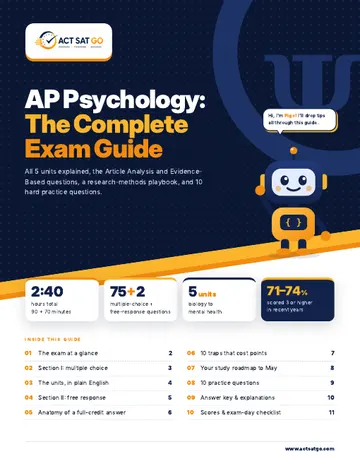
The exam at a glance
| Section | Weight | Timing | What you do |
|---|---|---|---|
| I · Multiple choice | about 67% | 1 hr 30 min · 75 questions | Apply concepts and theories to scenarios, evaluate research methods and study designs, and interpret data from tables and graphs. |
| II · Free response | about 33% | 1 hr 10 min · 2 questions | Article Analysis Question (AAQ): analyze a summary of a research study. Evidence-Based Question (EBQ): build an argument using three provided sources. |
Everything happens in Bluebook
You answer every question, including the written responses, in College Board's Bluebook app. Responses are submitted automatically at the end, so practice typing timed answers before May.
Research methods run through everything
Expect questions on variables, sampling, operational definitions, statistics and ethics in every unit, not just a single research chapter.
The multiple-choice section
75 questions in 90 minutes gives you 1 minute 12 seconds per question. Most questions are short scenarios asking which concept applies. Wrong answers lose no points.
Strategies that work
- Find the key detail in the scenario that points to one concept, then match it.
- Separate look-alike terms: negative reinforcement vs punishment; proactive vs retroactive interference.
- Identify the research design: experiment (random assignment) or correlation (no manipulation).
- Read graphs for the variables before reading the question.
- Eliminate distractors that are real terms but don't fit the scenario.
- Move on at 90 seconds and return to flagged questions.
The 5 units, in plain English
Biological Bases of Behavior
The brain, nervous system, sleep and senses.
Be ready to: Explain neurons and neurotransmitters; brain regions and plasticity; the endocrine system; sleep stages and disorders; sensation and sensory thresholds.
Cognition
Perception, memory, thinking and intelligence.
Be ready to: Explain perception and attention; memory encoding, storage and retrieval; forgetting; problem-solving, heuristics and biases; intelligence and testing.
Development & Learning
How people grow and learn.
Be ready to: Describe physical, cognitive and social development (Piaget, Erikson); attachment; classical and operant conditioning; observational learning.
Social Psychology & Personality
How people affect each other, and who we are.
Be ready to: Explain attribution, conformity, obedience and group behavior; prejudice; personality perspectives and assessment; motivation and emotion.
Mental & Physical Health
Stress, disorders and treatment.
Be ready to: Explain stress and coping; positive psychology; DSM categories of disorders; biological and psychological treatments and their evidence.
The five units carry the same range, so balance your review. Research methods are tested in every unit: variables and operational definitions; random sampling vs random assignment; statistics (mean, median, standard deviation, correlation, significance); and ethics (informed consent, deception, debriefing, confidentiality).
The 2 free-response questions
70 minutes for 2 questions worth 7 points each. Both are based on sources, so they test how you use evidence, not just definitions.
Article Analysis Question
Read a summary of a research study. Identify the research method, variables, operational definitions, statistics and ethics, then explain whether the findings can be generalized.
Use the exact numbers and terms from the article in your answers.
Evidence-Based Question
Read three sources. Make a claim in response to a prompt, support it with evidence from at least two sources, and explain how each piece of evidence connects to a psychological concept.
Cite sources by number, and explain the concept; don't just quote.
Time plan: About 25 minutes for the AAQ (5 reading, 20 writing) and 45 minutes for the EBQ (10 reading the sources, 35 writing).
Habits that earn points
- Answer each part separately and in order.
- Use the study's exact numbers and terms.
- Name the psychological concept in every explanation.
- In the EBQ, cite at least two different sources.
- Stuck? Define the concept accurately and apply it.
10 traps that cost points
Negative reinforcement vs punishment
Negative reinforcement removes something unpleasant to increase a behavior; punishment decreases a behavior.
Random sampling vs random assignment
Random sampling helps generalize to a population; random assignment allows cause-and-effect conclusions.
Correlation as causation
A correlation shows a relationship, not that one variable causes the other.
Negative correlation as "weak"
r = −0.85 is a strong correlation. The sign shows direction, not strength.
Proactive vs retroactive interference
Proactive: old information disrupts new. Retroactive: new information disrupts old.
Sensation vs perception
Sensation detects stimuli; perception organizes and interprets them.
Classical vs operant conditioning
Classical pairs stimuli (involuntary responses); operant uses consequences (voluntary behavior).
Validity vs reliability
Reliability is consistency; validity is measuring what a test claims to measure.
Definitions instead of application
Free-response answers need the concept applied to the specific scenario.
Ignoring the sources in the EBQ
Evidence must come from the provided sources, cited and explained.
A study roadmap to May
A steady plan beats a last-minute rush. Shift the months to match your teacher's pacing.
- Sep – Oct
Unit 1 + research methods
Neurons, the brain, sleep and senses. Learn the research-methods vocabulary early.
- Nov – Dec
Unit 2: cognition
Perception, memory, thinking and intelligence. Start AAQ practice with short study summaries.
- Jan – Feb
Unit 3: development and learning
Development and learning theories. Practice applying conditioning terms to scenarios.
- Mar – Apr
Units 4–5: people and health
Social psychology, personality, disorders and treatment. Write timed EBQs.
- Early May
Full timed sections
Full 75-question sets and both free-response types under timing.
- May 2027
Exam day
Friday, May 14, 2027 (afternoon session). Sleep well and confirm your start time with your AP coordinator.
3 practice questions
Original questions written by ACT SAT GO in the style of the exam. The free PDF has 10, with full explanations.
- Research methods
A study finds r = −0.72 between hours of social media use and sleep quality. Which conclusion is justified?
- A Social media use causes poor sleep
- B There is a weak relationship because r is negative
- C There is a strong negative relationship between the two variables
- D Poor sleep causes people to use social media
Show answer
Answer: C. r = −0.72 shows a strong negative correlation. Correlations don't establish causation in either direction.
- Unit 3 · Conditioning
A driver buckles her seat belt to stop an annoying beeping sound. Buckling up is maintained by:
- A positive reinforcement
- B positive punishment
- C extinction
- D negative reinforcement
Show answer
Answer: D. Removing an unpleasant stimulus (the beeping) increases the behavior: negative reinforcement.
- Unit 4 · Social psychology
Seeing a classmate trip, Sam thinks "he's so clumsy," but when Sam trips he blames the wet floor. This shows:
- A the actor-observer bias
- B the mere-exposure effect
- C groupthink
- D social facilitation
Show answer
Answer: A. The actor-observer bias attributes others' behavior to disposition and our own to the situation.
How students score
Ranges reflect recent College Board score distributions and shift a little each year. Credit and placement policies vary by college.
Aiming for a 5 in AP Psychology?
Book a free diagnostic session. We'll find your weakest units, review your practice responses and give you a week-by-week plan to exam day.