The exam at a glance
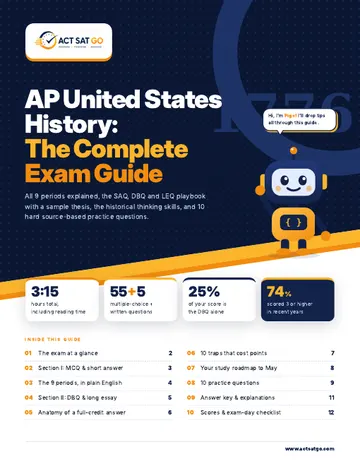
| Section | Weight | Timing | What you do |
|---|---|---|---|
| IA · Multiple choice | 40% | 55 min · 55 questions | Sets of usually 3–4 questions built around a primary or secondary source: texts, images, charts or maps. |
| IB · Short answer | 20% | 40 min · 3 questions | Q1 (secondary source or sources) and Q2 (primary source) are required; then choose Q3 or Q4 (no source). Each has three parts. |
| II · Document-based question | 25% | 60 min, including a 15-min reading period · 1 essay | Write an argument using 7 documents plus your own knowledge. The DBQ covers 1754–1980. |
| II · Long essay | 15% | 40 min · 1 essay | Choose one of three prompts, each covering a different span of time periods, and write an argument. |
Everything happens in Bluebook
You answer every question, including the written responses, in College Board's Bluebook app. Responses are submitted automatically at the end, so practice typing timed answers before May.
Essays use the same rubric every year
The DBQ (7 points) and long essay (6 points) are scored on thesis, contextualization, evidence and analysis.
Multiple choice and short answer
55 multiple-choice questions in 55 minutes (one minute each), then 3 short-answer questions in 40 minutes. Most questions use a source, and wrong answers lose no points.
Strategies that work
- Read the source line first: author, date and audience tell you the context before you read the text.
- Answer the question asked. "Which development most directly caused…" means a cause, not just a related event.
- For short answers, use ACE: Answer the question, Cite specific evidence, Explain how it supports your answer.
- One part, one paragraph. Label each short-answer part (a), (b), (c) and answer in 2–3 sentences.
- Be specific: name people, laws, events and dates. Vague answers rarely earn the point.
- Never leave a blank. Guess, flag and move on at the one-minute mark.
The 9 periods, in plain English
1491–1607
Contact and colonization.
Know: Native American societies before contact; the Columbian Exchange; Spanish colonization and the encomienda system.
1607–1754
The colonial era.
Know: Differences between colonial regions; Atlantic trade and slavery; mercantilism; the Great Awakening and Enlightenment ideas.
1754–1800
Revolution and a new republic.
Know: The Seven Years' War; causes and effects of the Revolution; the Articles of Confederation; the Constitution and the first party system.
1800–1848
A growing democracy.
Know: Jeffersonian and Jacksonian democracy; the market revolution; the Second Great Awakening and reform; Indian Removal.
1844–1877
Expansion, Civil War and Reconstruction.
Know: Manifest Destiny and the Mexican-American War; the sectional crisis; the Civil War; Reconstruction and its end.
1865–1898
The Gilded Age.
Know: Industrialization and big business; immigration and urbanization; labor unions; Populism and the West.
1890–1945
Progressives, world wars and the New Deal.
Know: Imperialism; the Progressive Era; World War I; the 1920s; the Great Depression and New Deal; World War II.
1945–1980
Cold War America.
Know: The Cold War and containment; the civil rights movement; the Great Society; Vietnam; social movements and the rise of conservatism.
1980–present
Modern America.
Know: The Reagan era; the end of the Cold War; globalization and technology; debates over the role of government; responses to terrorism.
Periods 3–8 (1754–1980) each carry 10–17% and together make up most of the exam. Every task also tests the historical thinking skills: sourcing, contextualization, comparison, and causation and continuity and change over time.
The DBQ and the long essay
100 minutes for two essays, both scored with fixed rubrics. The DBQ rubric is 7 points: thesis 1, contextualization 1, evidence 3, analysis and reasoning 2. The long essay uses the same rows with 2 evidence points (6 in total).
Document-based question
Use at least 4 documents to support an argument for full evidence credit, add one piece of outside evidence, and explain sourcing for at least 2 documents.
Group documents into 2–3 categories that each prove part of your thesis.
Long essay question
No documents: the evidence comes from your own knowledge. Choose the prompt carefully, then argue a clear line of reasoning.
Pick the prompt for which you know the most specific evidence.
A historically defensible claim
One or two sentences that make a claim and set out a line of reasoning, in the introduction or conclusion.
"Although X, Y mainly because A and B" shows complexity from the start.
Contextualization
Describe broader developments before, during or after the period that relate to the prompt, in several sentences.
Write it as your opening paragraph so you don't forget it.
Time plan: 15 minutes reading the documents, 45 minutes writing the DBQ, 5 minutes planning the long essay and 35 minutes writing it. The complexity point is the hardest: earn it by analyzing multiple variables, qualifying your argument or connecting across periods.
Habits that earn points
- Underline every task verb in the prompt before you plan.
- Write a defensible thesis in your first paragraph.
- Back every claim with specific evidence, then explain it.
- Keep 2 minutes to reread and fix unclear sentences.
- Stuck? Answer each part separately, in order. Partial credit is real.
10 traps that cost points
Restating the prompt as a thesis
A thesis must take a position and give reasons. Repeating the question earns no point.
Listing documents
"Document 1 says… Document 2 says…" is summary. Use documents as evidence for your argument.
Sourcing by labeling
"The author is a merchant" isn't enough. Explain how that affects the document's message.
One-sentence context
Contextualization needs several sentences about the broader situation, connected to the prompt.
Outside evidence from the documents
Outside evidence must be a specific fact that is not in any document.
Wrong time period
Evidence from outside the prompt's dates doesn't count. Check the years before writing.
Vague SAQ answers
Short answers need a specific example and an explanation, not a general statement.
Running out of time on the DBQ
Watch the clock. A rushed long essay costs more than a slightly shorter DBQ.
Presentism
Judge events by their own time's context, and avoid "always" or "never" claims.
Skipping the conclusion
A conclusion is a second chance to state the thesis or earn the complexity point.
A study roadmap to May
A steady plan beats a last-minute rush. Shift the months to match your teacher's pacing.
- Sep – Oct
Periods 1–3: colonial to republic
Contact, colonial regions and the Revolution. Practice sourcing on one document a day.
- Nov – Dec
Periods 4–5: a growing nation
Jacksonian era, reform, expansion, the Civil War and Reconstruction. Write your first short answers.
- Jan – Feb
Periods 6–7: industry and empire
Gilded Age, Progressives, the World Wars and the New Deal. Write a timed DBQ every two weeks.
- Mar – Apr
Periods 8–9: modern America
Cold War, civil rights and recent history. Alternate DBQs and long essays.
- Early May
Full timed sections
Practice the full Section I and both essays under timing. Review the rubric and the traps list.
- May 2027
Exam day
Friday, May 7, 2027 (morning session). Sleep well and confirm your start time with your AP coordinator.
3 practice questions
Original questions written by ACT SAT GO in the style of the exam. The free PDF has 10, with full explanations.
- Period 3 · Causation
Which development most directly increased tensions between Britain and its North American colonies after 1763?
- A The arrival of the first enslaved Africans in Virginia
- B The Louisiana Purchase
- C The ratification of the Constitution
- D British efforts to tax the colonies to pay debts from the Seven Years' War
Show answer
Answer: D. Debt from the Seven Years' War led Parliament to pass the Sugar, Stamp and Townshend Acts, provoking "no taxation without representation" protests.
- Period 7 · Argumentation
Which piece of evidence best supports the claim that the New Deal permanently expanded the federal government's role in the economy?
- A The Civilian Conservation Corps ended in 1942
- B Social Security continued to provide benefits long after the 1930s
- C The Supreme Court struck down the NRA in 1935
- D Unemployment remained high until World War II
Show answer
Answer: B. Social Security's long-term survival shows lasting federal involvement. The other choices show programs ending, limits on the New Deal or its shortfalls.
- Period 8 · Causation
Which was a major effect of the Supreme Court's decision in Brown v. Board of Education (1954)?
- A It immediately ended segregation in all Southern schools
- B It guaranteed voting rights for all African Americans
- C It created the Equal Employment Opportunity Commission
- D It overturned the "separate but equal" doctrine of Plessy v. Ferguson for public schools
Show answer
Answer: D. Brown ruled school segregation unconstitutional, overturning Plessy for schools. Desegregation itself was slow and resisted.
How students score
Ranges reflect recent College Board score distributions and shift a little each year. Credit and placement policies vary by college.
Aiming for a 5 in AP United States History?
Book a free diagnostic session. We'll find your weakest units, review your practice responses and give you a week-by-week plan to exam day.