The exam at a glance
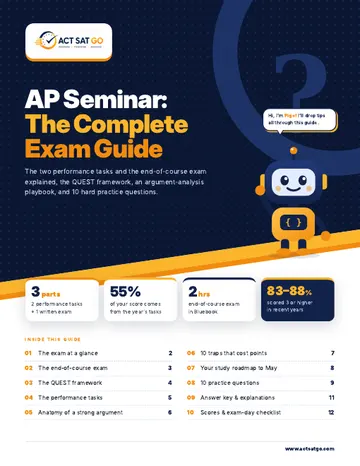
| Section | Weight | Timing | What you do |
|---|---|---|---|
| PT 1 · Team project & presentation | 20% | 1,200 words + 8–10 min | Individual research report (1,200 words, scored by College Board) and a team multimedia presentation and defense (8–10 minutes, scored by your teacher). |
| PT 2 · Individual research-based essay & presentation | 35% | 2,000 words + 6–8 min | Written argument (2,000 words, scored by College Board) based on stimulus texts, a presentation (6–8 minutes) and an oral defense (2 questions), both scored by your teacher. |
| End-of-course exam | 45% | 2 hr · 4 questions | 3 short-answer questions analyzing an argument in one source, and 1 essay synthesizing four sources into your own argument. |
Tasks go to the AP Digital Portfolio
Your written work for both performance tasks is submitted in the AP Digital Portfolio by April 30, 2027, 11:59 p.m. ET. The end-of-course exam is taken in Bluebook.
Your work must be your own
College Board checks for plagiarism and requires proper citation. Teachers and tutors can teach skills, but they can't give feedback on the specific work you submit.
The end-of-course exam
A 2-hour digital exam in May with no multiple choice. Part A: 3 short answers that identify an author's argument, explain the line of reasoning and evaluate the evidence. Part B: an essay that builds your own argument using at least two of four sources, with perspectives that connect to a common theme.
Strategies that work
- Find the claim first: what does the author want readers to believe?
- Trace the line of reasoning: how does each step support the claim?
- Evaluate evidence: is it relevant, credible and sufficient?
- In the essay, argue: don't summarize sources; use them to support your own position.
- Connect perspectives: show how sources agree, disagree or add nuance.
- Budget time: about 30 minutes for Part A and 90 for Part B.
The QUEST framework
Question & Explore
Start with a real problem.
Be ready to: Identify a problem or issue, develop a focused research question, and find relevant, credible sources.
Understand & Analyze
Read critically.
Be ready to: Read for purpose; identify claims, reasoning and evidence; evaluate an argument's strength.
Evaluate Multiple Perspectives
See the issue from several sides.
Be ready to: Compare perspectives on an issue; explain their assumptions and implications; evaluate competing arguments.
Synthesize Ideas
Build your own argument.
Be ready to: Combine evidence from multiple sources into your own argument; reach a reasoned conclusion and propose solutions.
Team, Transform & Transmit
Collaborate and communicate.
Be ready to: Work in a team; adapt your message for an audience; present and defend your work orally and in writing.
Seminar has no fixed content. You apply these five big ideas to any topic, so practice asking "what is the argument, and how strong is the evidence?" about everything you read.
The performance tasks
Two research projects completed in class during the year make up 55% of your score: Performance Task 1 (20%) and Performance Task 2 (35%).
Individual Research Report
PT 1 · 1,200 words. Research one lens or perspective on your team's problem, evaluate your sources, and explain how your research contributes to the team's understanding.
Explain why each source is credible, not just what it says.
Team Multimedia Presentation
PT 1 · 8–10 min + defense. Your team proposes a solution that brings together members' perspectives, presents it, and answers questions.
Show how each member's lens shaped the solution.
Individual Written Argument
PT 2 · 2,000 words. Using stimulus materials provided by College Board, write your own research question and an evidence-based argument.
Use at least one stimulus text; add strong outside research.
Presentation & oral defense
PT 2 · 6–8 min + 2 questions. Present your argument and answer two questions from your teacher about your research process and conclusions.
Practice explaining your research choices, not just your findings.
Time plan: For the IWA, about 1 week to explore the stimulus, 2 weeks to research, 2 weeks to draft and 1 week to revise and cite. Your teacher sets the actual schedule.
Habits that earn points
- Write a focused, debatable research question.
- Evaluate each source's credibility and bias.
- Use sources as evidence, not as the argument.
- Acknowledge limitations and counterarguments.
- Cite every source accurately and consistently.
10 traps that cost points
Summary instead of analysis
Explaining what a source says isn't enough. Evaluate its reasoning and evidence.
Too broad a question
"How can we fix climate change?" is too big. Narrow to a place, group or solution.
Weak sources
Rely on credible, peer-reviewed or expert sources and explain why they are credible.
One perspective only
Strong arguments consider multiple perspectives and respond to counterarguments.
Missing citations
Uncited ideas count as plagiarism, which can score 0 on a task.
Over the word limit
Respect limits: 1,200 words for the IRR and 2,000 for the IWA.
Ignoring the stimulus
The IWA must connect to at least one stimulus text provided by College Board.
Solutions without evidence
Proposed solutions need support and should address limitations.
Reading the presentation
Speak to the audience; slides should support, not replace, your talk.
Unprepared oral defense
Expect questions on your research process, not just conclusions.
A study roadmap to May
A steady plan beats a last-minute rush. Shift the months to match your teacher's pacing.
- Sep – Oct
QUEST skills
Practice argument analysis, source evaluation and short presentations on low-stakes topics.
- Nov – Jan
Performance Task 1: team project
Research your lens, write the IRR (1,200 words), and build the team presentation.
- Feb – Apr
Performance Task 2: individual research
Explore the stimulus texts, research, write the IWA (2,000 words), and prepare the presentation and defense.
- April 30
Final submission
Submit all written components in the AP Digital Portfolio by 11:59 p.m. ET.
- Early May
Timed Part A and Part B
Practice short-answer analysis and four-source essays under timing.
- May 2027
Exam day
Monday, May 10, 2027 (afternoon session). Sleep well and confirm your start time with your AP coordinator.
3 practice questions
Original questions written by ACT SAT GO in the style of the exam. The free PDF has 10, with full explanations.
- Argument · Evaluation
A source cites a study of twelve European cities where car bans raised weekday foot traffic by 18%, then concludes that "pedestrian-first design is good for business everywhere." The biggest weakness in this reasoning is that:
- A it generalizes to "everywhere" from a sample of European cities only
- B it uses numbers
- C it mentions critics
- D it studies weekday visitors
Show answer
Answer: A. Evidence from twelve European cities doesn't justify "everywhere": the generalization exceeds the evidence.
- Research question
Which is the most effective research question for an IWA?
- A To what extent do school phone bans improve students' in-class attention in U.S. high schools?
- B What is social media?
- C Is social media good or bad?
- D Why do people like phones?
Show answer
Answer: A. It is focused (place, group, measurable outcome) and debatable, using "to what extent".
- Reasoning
"Students who eat breakfast earn higher grades, so breakfast causes higher grades." This reasoning confuses:
- A a definition with an example
- B a claim with a counterclaim
- C correlation with causation
- D qualitative with quantitative data
Show answer
Answer: C. An association between breakfast and grades doesn't prove breakfast causes them; other factors may explain both.
How students score
Ranges reflect recent College Board score distributions and shift a little each year. Credit and placement policies vary by college.
Aiming for a 5 in AP Seminar?
Book a free diagnostic session. We'll find your weakest units, review your practice responses and give you a week-by-week plan to exam day.