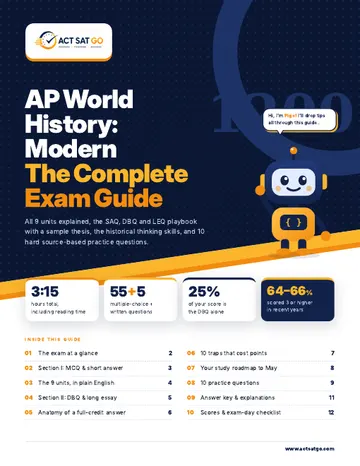
The exam at a glance
| Section | Weight | Timing | What you do |
|---|---|---|---|
| IA · Multiple choice | 40% | 55 min · 55 questions | Sets of usually 3–4 questions built around a primary or secondary source: texts, images, charts or maps. |
| IB · Short answer | 20% | 40 min · 3 questions | Q1 (secondary source or sources) and Q2 (primary source) are required; then choose Q3 or Q4 (no source). Each has three parts. |
| II · Document-based question | 25% | 60 min, including a 15-min reading period · 1 essay | Write an argument using 7 documents plus your own knowledge. The DBQ covers 1450–2001. |
| II · Long essay | 15% | 40 min · 1 essay | Choose one of three prompts, each covering a different span of time periods, and write an argument. |
Everything happens in Bluebook
You answer every question, including the written responses, in College Board's Bluebook app. Responses are submitted automatically at the end, so practice typing timed answers before May.
Essays use the same rubric every year
The DBQ (7 points) and long essay (6 points) are scored on thesis, contextualization, evidence and analysis.
Multiple choice and short answer
55 multiple-choice questions in 55 minutes (one minute each), then 3 short-answer questions in 40 minutes. Most questions use a source, and wrong answers lose no points.
Strategies that work
- Read the source line first: author, date and audience tell you the context before you read the text.
- Answer the question asked. "Which development most directly caused…" means a cause, not just a related event.
- For short answers, use ACE: Answer the question, Cite specific evidence, Explain how it supports your answer.
- One part, one paragraph. Label each short-answer part (a), (b), (c) and answer in 2–3 sentences.
- Be specific: name people, laws, events and dates. Vague answers rarely earn the point.
- Never leave a blank. Guess, flag and move on at the one-minute mark.
The 9 units, in plain English
The Global Tapestry
c. 1200–1450.
Be ready to: Song China; Dar al-Islam; South and Southeast Asia; states in the Americas and Africa; feudal Europe.
Networks of Exchange
c. 1200–1450.
Be ready to: The Silk Roads; the Mongol Empire; Indian Ocean and trans-Saharan trade; the spread of religions, technologies and disease.
Land-Based Empires
c. 1450–1750.
Be ready to: The Ottoman, Safavid, Mughal and Qing empires; how rulers legitimized and consolidated power; gunpowder empires.
Transoceanic Interconnections
c. 1450–1750.
Be ready to: Maritime exploration; the Columbian Exchange; the Atlantic slave trade; colonial labor systems; resistance to European expansion.
Revolutions
c. 1750–1900.
Be ready to: The Enlightenment; the American, French, Haitian and Latin American revolutions; nationalism; the Industrial Revolution's origins.
Consequences of Industrialization
c. 1750–1900.
Be ready to: New imperialism; resistance to imperialism; migration; economic imperialism; global effects of industrial growth.
Global Conflict
c. 1900–present.
Be ready to: Causes and effects of World War I; the interwar period and Great Depression; totalitarian states; World War II and genocide.
Cold War & Decolonization
c. 1900–present.
Be ready to: Superpower rivalry and proxy wars; decolonization in Asia and Africa; new states; movements for civil rights and independence.
Globalization
c. 1900–present.
Be ready to: Advances in technology and medicine; environmental change; economic globalization; social movements; international organizations.
Units 3–6 (about 1450–1900) carry the most weight, and that is where most essays come from too. Every task also tests the historical thinking skills: sourcing, contextualization, comparison, and causation and continuity and change over time.
The DBQ and the long essay
100 minutes for two essays, both scored with fixed rubrics. The DBQ rubric is 7 points: thesis 1, contextualization 1, evidence 3, analysis and reasoning 2. The long essay uses the same rows with 2 evidence points (6 in total).
Document-based question
Use at least 4 documents to support an argument for full evidence credit, add one piece of outside evidence, and explain sourcing for at least 2 documents.
Group documents into 2–3 categories that each prove part of your thesis.
Long essay question
No documents: the evidence comes from your own knowledge. Choose the prompt carefully, then argue a clear line of reasoning.
Pick the prompt for which you know the most specific evidence.
A historically defensible claim
One or two sentences that make a claim and set out a line of reasoning, in the introduction or conclusion.
"Although X, Y mainly because A and B" shows complexity from the start.
Contextualization
Describe broader developments before, during or after the period that relate to the prompt, in several sentences.
Write it as your opening paragraph so you don't forget it.
Time plan: 15 minutes reading the documents, 45 minutes writing the DBQ, 5 minutes planning the long essay and 35 minutes writing it. The complexity point is the hardest: earn it by analyzing multiple variables, qualifying your argument or connecting across periods.
Habits that earn points
- Underline every task verb in the prompt before you plan.
- Write a defensible thesis in your first paragraph.
- Back every claim with specific evidence, then explain it.
- Keep 2 minutes to reread and fix unclear sentences.
- Stuck? Answer each part separately, in order. Partial credit is real.
10 traps that cost points
Restating the prompt as a thesis
A thesis must take a position and give reasons. Repeating the question earns no point.
Listing documents
"Document 1 says… Document 2 says…" is summary. Use documents as evidence for your argument.
Sourcing by labeling
"The author is a merchant" isn't enough. Explain how that affects the document's message.
One-sentence context
Contextualization needs several sentences about the broader situation, connected to the prompt.
Outside evidence from the documents
Outside evidence must be a specific fact that is not in any document.
Wrong time period
Evidence from outside the prompt's dates doesn't count. Check the years before writing.
Vague SAQ answers
Short answers need a specific example and an explanation, not a general statement.
Running out of time on the DBQ
Watch the clock. A rushed long essay costs more than a slightly shorter DBQ.
Presentism
Judge events by their own time's context, and avoid "always" or "never" claims.
Skipping the conclusion
A conclusion is a second chance to state the thesis or earn the complexity point.
A study roadmap to May
A steady plan beats a last-minute rush. Shift the months to match your teacher's pacing.
- Sep – Oct
Units 1–2: c. 1200–1450
States and trade networks before 1450. Practice comparison: two empires, one similarity, one difference.
- Nov – Dec
Units 3–4: c. 1450–1750
Land-based empires and oceanic exchange. Write your first short answers and a practice DBQ.
- Jan – Feb
Units 5–6: c. 1750–1900
Revolutions, industrialization and imperialism. A timed DBQ every two weeks.
- Mar – Apr
Units 7–9: c. 1900–present
World wars, Cold War, decolonization and globalization. Alternate DBQs and long essays.
- Early May
Full timed sections
Full Section I and both essays under timing. Review the rubric and the traps list.
- May 2027
Exam day
Thursday, May 6, 2027 (morning session). Sleep well and confirm your start time with your AP coordinator.
3 practice questions
Original questions written by ACT SAT GO in the style of the exam. The free PDF has 10, with full explanations.
- Unit 2 · Comparison
Trade in the Indian Ocean before 1450 differed from trade along the Silk Roads mainly because Indian Ocean trade:
- A was controlled by a single empire
- B moved only luxury goods
- C had no role in spreading religion
- D relied on monsoon winds and carried larger quantities of bulk goods
Show answer
Answer: D. Monsoon winds allowed predictable sea routes that could carry bulk goods. Overland Silk Road trade focused more on high-value luxury goods.
- Unit 4 · Causation
Which factor best explains the rapid growth of the Atlantic slave trade after 1600?
- A Demand for labor on plantations in the Americas after Indigenous populations collapsed
- B The decline of sugar plantations
- C The end of the Columbian Exchange
- D Industrial factories in Africa
Show answer
Answer: A. Disease and harsh labor collapsed Indigenous populations; plantation owners, especially in sugar, turned to enslaved Africans for labor.
- Unit 8 · Comparison
Independence movements in India and in Algeria differed most in that:
- A Algeria gained independence before India
- B India remained a French colony
- C India's independence was largely achieved through nonviolent mass protest, while Algeria's involved a long armed war
- D Neither movement was influenced by nationalism
Show answer
Answer: C. India's movement used mass nonviolent protest under Gandhi; Algeria fought a long, violent war against France (1954–1962).
How students score
Ranges reflect recent College Board score distributions and shift a little each year. Credit and placement policies vary by college.
Aiming for a 5 in AP World History: Modern?
Book a free diagnostic session. We'll find your weakest units, review your practice responses and give you a week-by-week plan to exam day.