The exam at a glance
| Section | Weight | Timing | What you do |
|---|---|---|---|
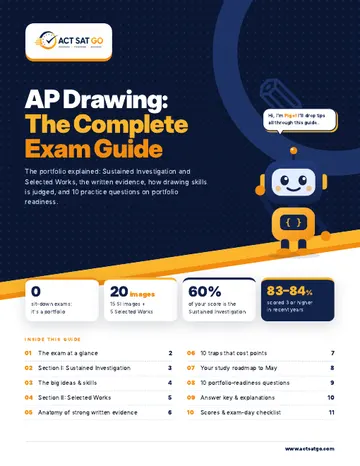
| I · Sustained Investigation | 60% | 15 digital images | A body of work driven by a question you choose. Show practice, experimentation and revision, with written evidence of your inquiry and how the work developed. |
| II · Selected Works | 40% | 5 digital images | Five finished works that show drawing skills and synthesis of materials, processes and ideas. Each has a short written description of ideas, materials and processes. |
A portfolio, not a sit-down exam
You upload images and written evidence to the AP Digital Portfolio, and your teacher forwards it to College Board before the deadline. Finish early so there is time for both steps.
Scored by experts
Portfolios are scored by at least four experienced AP Art and Design teachers or college faculty, trained to apply the same rubric. Each section is scored separately.
Sustained Investigation
The heart of the portfolio: 15 images that show an inquiry-driven body of work and how it grew through practice, experimentation and revision. Readers look at your inquiry, your practice and revision, how materials and ideas come together, and your drawing skills. You briefly identify the inquiry and describe how it developed, and list materials and processes for each image.
Strategies that work
- Ask an open question you can explore in many ways, not a single theme you illustrate once.
- Show process images: sketches, tests and failed attempts count as evidence of experimentation.
- Let the work change. Readers reward visible growth and new directions.
- Connect images so the 15 read as one investigation, not 15 separate projects.
- Push your drawing skills across the body of work.
- Write briefly and specifically: name the decisions you made and why.
The drawing skills readers look for
Mark-making
Line quality, gesture and expressive marks.
Be ready to: show mark-making across your Sustained Investigation and Selected Works.
Value & light
Light and shade to create form and mood.
Be ready to: show value & light across your Sustained Investigation and Selected Works.
Space & depth
Perspective, overlap and scale.
Be ready to: show space & depth across your Sustained Investigation and Selected Works.
Composition
Arranging the surface with purpose.
Be ready to: show composition across your Sustained Investigation and Selected Works.
The course is organized around three big ideas: investigate materials, processes and ideas; make art and design through practice, experimentation and revision; and present your work with clear written statements that explain your growth.
Selected Works
Five works that show your strongest drawing skills. They can come from your Sustained Investigation, or be completely separate. Readers look for skill and a strong synthesis of materials, processes and ideas.
Your five strongest works
Choose finished works that best show skill and synthesis, not your favorite subjects.
Ask someone honest which five are weakest.
A short written description
For each work, briefly identify the ideas, materials and processes used, plus citations for any sources or pre-existing works.
Be specific: "graphite and charcoal on toned paper", not just "drawing".
Photograph carefully
Use even light, a neutral background, sharp focus and true color, with no glare on graphite or charcoal. Crop out everything that isn't the artwork.
Poor photos can hide strong work.
Original work
Work must be your own. If you use a photo or another artist's work as a reference, you must transform it significantly and cite it.
Copying a photo without transformation can disqualify a work.
Time plan: Work back from the deadline: about 2 weeks to select works, 1–2 weeks to photograph, 1 week to write and 1 week to upload and check. The deadline is Friday, May 7, 2027, 11:59 p.m. ET.
Habits that earn points
- Photograph process and finished work as you go.
- Keep a sketchbook or log of every decision.
- Write evidence in plain, specific language.
- Cite any reference images or sources.
- Get honest feedback on your weakest five images.
10 traps that cost points
Theme instead of inquiry
"Nature" is a theme. "How can texture show the passage of time?" is an inquiry that drives work.
No visible growth
Fifteen similar finished works don't show practice, experimentation or revision.
Hiding process
Sketches and tests are evidence. Include and label them.
Vague writing
"I explored my feelings" says little. Name materials, decisions and changes.
Copying photos
Work based on others' images must be significantly transformed and cited.
Poor photography
Blurry, glare-filled or badly cropped images hide your skill.
Disconnected works
Your investigation should read as one connected body of work.
Weak Selected Works
Choose the five works that best show skill and synthesis, not just your favorites.
Ignoring composition
Readers judge composition and design decisions, not just technique.
Missing the deadline
Upload, write and submit early; your teacher must also forward the portfolio.
A study roadmap to May
A steady plan beats a last-minute rush. Shift the months to match your teacher's pacing.
- Sep – Oct
Explore skills and possible inquiries
Experiment with materials and processes. Fill a sketchbook and brainstorm several possible questions.
- Nov – Dec
Choose your inquiry
Pick the question you'll investigate and start making connected work. Photograph everything.
- Jan – Mar
Practice, experiment, revise
Build toward 15 images. Get feedback, revise, and let the investigation change direction.
- April
Choose Selected Works
Pick your five strongest works. Photograph them carefully and draft the written descriptions.
- May 7, 2027
Portfolio deadline
Upload images and writing to the AP Digital Portfolio and submit by 11:59 p.m. ET. Scores are released in July.
3 practice questions
Original questions written by ACT SAT GO in the style of the exam. The free PDF has 10, with full explanations.
- Inquiry
Which is the strongest guiding inquiry for a Sustained Investigation?
- A My dog
- B Drawings of flowers
- C Things I like
- D How can changes in line weight show emotional tension in portraits?
Show answer
Answer: D. It is an open, exploratory question about a specific drawing decision. The others are subjects or themes.
- Drawing skills
Which best describes the drawing skill of using light and shade to create the illusion of form?
- A Gesture
- B Collage
- C Value and modeling
- D Typography
Show answer
Answer: C · Value and modeling. Value and modeling use light and shade to suggest three-dimensional form.
- Revision
Which statement best shows revision in written evidence?
- A "I finished the drawing."
- B "After critique, I reduced detail in the background so the figure's gesture became the focus."
- C "I like this one most."
- D "It took three hours."
Show answer
Answer: B. It names a specific change and the reason for it, which is clear evidence of revision.
How students score
Ranges reflect recent College Board score distributions and shift a little each year. Credit and placement policies vary by college.
Aiming for a 5 in AP Drawing?
Book a free diagnostic session. We'll find your weakest units, review your practice responses and give you a week-by-week plan to exam day.